
Bing's New AI Dashboard Tells You If Your
Content Is Showing Up in AI Answers
by Allison Brown, Enterprise SEO Manager @ Propellic
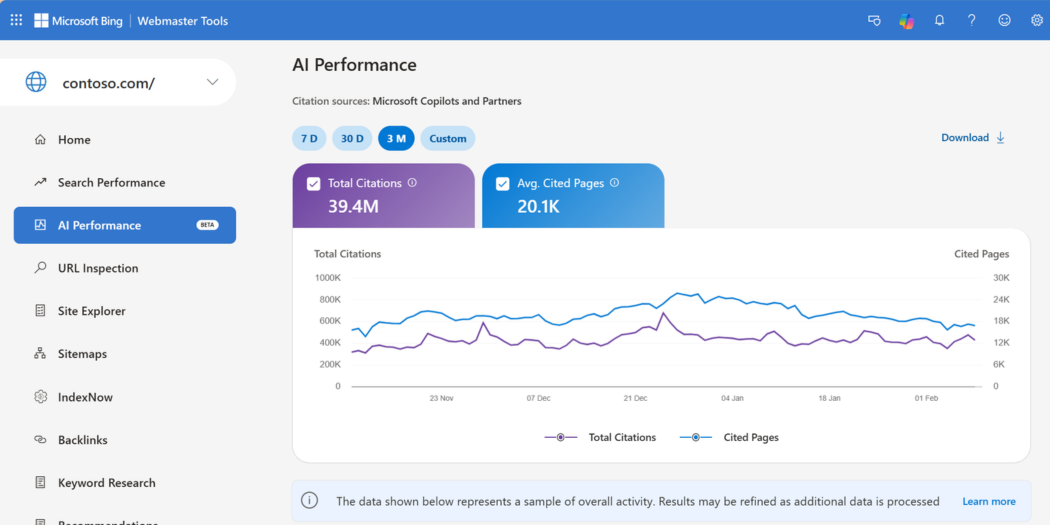
If you've been wondering whether your website actually shows up when someone asks Copilot or Bing's AI a question, now you can find out. Microsoft just launched AI Performance in Bing Webmaster Tools, a free dashboard that tracks how often your content is cited in AI-generated answers.
Why This Matters
Search behavior is shifting. People aren't just clicking blue links anymore; they're getting direct answers generated by AI. If your content isn't being cited in those answers, you're losing visibility you can't even see. That's exactly the problem this tool solves.
AI Performance is a new set of insights that shows how your content appears across Microsoft Copilot, AI-generated summaries in Bing, and select partner integrations, giving you clear visibility into which URLs are referenced and how citation activity changes over time.
This release is part of Bing's ongoing push into Generative Engine Optimization (GEO) tooling, helping publishers understand how their content participates in AI-driven experiences.
What the Dashboard Actually Shows You
Once you log into Bing Webmaster Tools, the AI Performance dashboard gives you five key metrics:
- Total Citations - How many times your content was shown as a source in AI-generated answers
- Average Cited Pages - The daily average of unique pages from your site being referenced by AI
- Grounding Queries - The phrases used when pulling your content into an answer
- Page-Level Citation Activity - Which specific URLs on your site are cited most often
- Visibility Trends Over Time - A timeline so you can spot patterns and changes at a glance
How to Use These Insights to Strengthen Your Content
The dashboard isn't just a vanity metric - it's a content strategy tool. Here's how to put it to work:
- Identify your top-cited pages and double down on those topics with deeper, more comprehensive coverage.
- Review your grounding queries to understand which phrases AI associates with your content, then optimize accordingly.
- Improve structure on underleveraged pages - clear headings, FAQ sections, and tables make it easier for AI to pull and reference your content accurately.
- Keep content fresh - outdated pages get replaced. Regular updates signal to AI systems that your content is up to date and reliable.
One More Tool Worth Enabling: IndexNow
IndexNow helps keep your information fresh across search and AI experiences by notifying participating search engines whenever content is added, updated, or removed, so AI systems always reference your most current page, not an old cached version. If you're not using it yet, setup is free at: https://www.bing.com/indexnow.
The Bottom Line
AI search isn't coming - it's already here. And now, for the first time, you have a free tool that tells you exactly how your content is performing inside it. Log in to Bing Webmaster Tools, navigate to the AI Performance tab, and see where you stand.
Want help interpreting your AI Performance data or building a GEO strategy around it?
Schedule a call with our team, and we'll walk you through it together.
World Cup 2026 Travel Trends Are Turning Match Trips Into Multi-City Vacations

by Javier Hernandez, Senior SEO Manager @ Propellic
If you’re planning for summer 2026 demand like it’s a weekend spike, you’re going to get blindsided. The World Cup is pulling travelers into longer stays, bigger groups, and multi-stop itineraries that squeeze inventory across entire regions.
The demand surge is already visible
Expedia’s first Fan Travel Outlook showed global interest in traveling to matches next summer was up 125% year over year in its July 2025 Fan Travel Outlook. Then, once the draw was announced, Expedia saw an additional short-term spike: searches for host cities jumped 245% in the immediate post-draw window covered in its December 2025 update, with Boston up 1000% and Dallas up 900% in that same post-draw period.
Hotels are seeing it too. SiteMinder data shared via Hotel Management coverage shows forward booking volumes more than doubled around several fixtures, alongside clear average daily rate lift.
Short-term rental supply is being actively pulled into the market. Airbnb is offering a $750 incentive to new hosts and says host city searches are up an average of 80 percent in its new host incentive announcement.
Multi-city travel is not a prediction, it is the default plan
The biggest behavioral shift is that fans are not just picking a match city. They are building itineraries.
Expedia is literally coaching people to road trip between host cities, use multi-city flights, and fly into alternate airports in that same Fan Travel Outlook. That is your signal the booking battle will be regional, not just local.
The booking problem nobody talks about
Even when demand is obvious, driving bookings is harder than it should be because you cannot market like it is a normal event.
FIFA controls commercial use of protected terms and marks, and brands can trip into trouble fast when they imply affiliation, run promotions that look like sponsorship, or use protected language in paid campaigns. Foster Garvey lays this out directly in Avoid a Penalty Card: The Legal Playbook for World Cup Marketing.
It gets even more operational near venues. Inglewood’s December 2025 staff memo describes event zone rules intended to regulate things like temporary structures and outdoor advertising displays near official events, including concepts often described as clean zones, in the City of Inglewood event zone memo.
Santa Clara’s guidance adds another layer by restricting mobile advertising displays and certain outdoor activations during designated periods inside the special event zone described on the City of Santa Clara ordinance page.
This is why some brands will see demand but still struggle to convert it. The easiest words to use are the ones you may not be able to use commercially, and the easiest places to activate are the ones that may be regulated.
What to do instead
This is not legal advice. Run campaign language and promotions through counsel. Then build a plan that does not depend on protected terms.
Use this playbook:
- Lead with city plus dates plus logistics, not the tournament name.
- Build multi-stop itineraries that connect nearby hosts, secondary cities, and alternative airports.
- Emphasize group readiness: inventory that fits groups, clear capacity messaging, flexible policies, easy transportation guidance.
- Never use match tickets as a promotional hook unless you are explicitly authorized.
- Shift creative from event language to travel outcomes: match week stays, summer 2026 soccer travel, host city weekends, watch party weekends where permitted.
With early bookings and host city searches already surging, the demand for summer 2026 is undeniable. Just remember that strict trademark protections mean your success will rely on marketing the broader travel experience rather than the event itself.
AI System Don't Read Your Page. They Chunk It.
.png)
by Eric Wimsatt, Associate Director SEO @ Propellic
When your content shows up in an AI Overview, a Perplexity answer, or a ChatGPT citation, the AI didn't process your whole page. It broke your content into token-sized segments (different sizes depending on the platform), converted each segment into a vector embedding, and retrieved whichever chunks best matched the user's query.
The atomic unit of AI search visibility isn't the page anymore. It's the chunk.
And if that chunk splits mid-thought, mixes two ideas, or repeats something you already said three paragraphs earlier, it produces a weaker embedding that's less likely to get retrieved for anything.
Here's the fun part: the article itself was written to follow its own recommendations. Every section contains one self-contained idea, sized to fit within a single chunk. And at the bottom of the post, there's a button that lets you see it.
Toggle it on and the article transforms to show you the exact chunk boundaries, overlap zones, and token counts, the same view an AI retrieval system would have of the page. It's the concept made tangible.
Read the full article and try the visualizer
Travel Marketing AI Summit Sponsored by Propellic

On March 24th, Propellic is heading to New York City as the Headline Sponsor for Phocuswright’s inaugural Travel Marketing AI Summit.
This isn’t your typical crowded trade show. It is a curated executive forum designed specifically to cut through the AI hype and focus on the tactical reality of our industry. We are proud to help lead this conversation alongside visionaries from Google, Hopper, Tripadvisor, and Booking.com.
Will you be in NYC? If you’re a senior leader defining your 2026 roadmap, this is the room you need to be in. We have a limited number of exclusive promo codes for our NavLog readers.
Get 20% Off the Prevailing Ticket Price
Want To Level Up Your Travel Marketing?
Subscribe to the NavLog, our bi-weekly travel marketing roundup, where you’ll be the first to know about breaking news that impacts travel marketers and access exclusive performance marketing strategies and practical tips you can implement from the marketers at the leading edge of the travel industry.
.png)