
What is GEO and How Does It Transform Travel Marketing?
by Allison Brown, Enterprise SEO Manager @ Propellic
The way travelers discover and plan their journeys is changing dramatically. Instead of scrolling through pages of search results, today's travelers are increasingly turning to AI chatbots and generative engines like ChatGPT, Claude, Perplexity, and Google's AI Overviews to ask conversational questions and receive synthesized recommendations.
This shift has created an entirely new challenge for travel marketers: how do you ensure your destination, hotel, or experience appears in these AI-generated answers?
The answer lies in Generative Engine Optimization (GEO), a revolutionary approach that's transforming how travel companies reach customers in the age of AI. In this guide, we'll explore what GEO means, how it fundamentally differs from traditional SEO, and why it's become essential for staying visible and competitive as search behavior evolves.
Understanding the Basics: What is Generative Engine Optimization (GEO)?
At its core, Generative Engine Optimization refers to the practice of optimizing your content to appear in AI-generated responses from large language models and generative search engines. Think about the last time you asked ChatGPT or Google's AI a travel question, perhaps "What are the best boutique hotels in Barcelona?" Instead of receiving a list of blue links to click through, you likely received a comprehensive, synthesized answer that pulled information from multiple sources to create a single, helpful response.
This is the new frontier of search, where travelers have conversations with AI assistants that understand context, remember previous questions, and provide personalized recommendations.
The Simple GEO Definition
In simple terms, GEO is the practice of creating and structuring content so it appears in AI-generated answers, not just in a traditional list of search results.
Consider a real-world scenario: a family planning a vacation asks Claude, "What's the best family-friendly resort in the Caribbean with a kids' club and water sports?" The AI will analyze countless sources and blend an answer that might specifically recommend your resort with detailed reasons why it's a good fit.
If your resort appears in that recommendation, you've just been introduced to a high-intent traveler through what amounts to a trusted third-party endorsement, but if you don't appear, you're invisible to that customer, regardless of how well your website might rank on traditional Google search.
The Deeper GEO Meaning and Concepts
Beyond the tactical definition, GEO represents a strategic shift in how travel businesses think about content and discoverability. It's about creating genuinely authoritative, well-structured content that AI systems can understand, trust, and merge into helpful responses for travelers.
Where SEO focused on signals like backlinks and keyword density, GEO emphasizes clarity, comprehensiveness, expertise, and the ability to directly answer complex travel questions.
This means your content strategy needs to evolve from creating thin pages targeting individual keywords to comprehensive resources that thoroughly address traveler questions with honest, detailed information rather than generic promotional material.
How GEO Works in Practice
Understanding how AI engines operate will help you create content that gets discovered and cited. When a traveler asks an AI assistant a travel question, the AI interprets the query (not just keywords but intent and context), retrieves relevant information from its knowledge base, and turns it into a coherent response, often citing authoritative sources.
Your goal is to become one of those authoritative sources that AI systems trust and reference when answering travel questions relevant to your business.
How AI Engines Retrieve and Synthesize Information
AI engines use large language models that understand language, context, and relationships between concepts rather than just matching keywords.
When someone asks about "romantic getaways in Tuscany," the AI understands they're looking for accommodations and experiences suited to couples, with an emphasis on ambiance and intimacy. Whether your content is included depends on the comprehensiveness of your information, the clarity of your writing, the authority signals on your site, and how well your content matches the searcher's intent.
AI systems are remarkably good at distinguishing between genuinely helpful content and generic marketing material.
Optimizing Content for AI Citation and Visibility
Making your content easily digestible for AI engines requires intentional structure: clear headings help AI understand your information's organization, bullet points make key details easy to extract, and structured data like schema markup provides explicit signals about what your content describes.
Beyond structure, AI systems prioritize sources that demonstrate expertise through original research, expert quotes, and up-to-date information. Specificity is your friend. Instead of saying "our hotel offers great amenities," describe exactly what those amenities are: "24-hour fitness center with Peloton bikes, rooftop pool open April through October, complimentary beach shuttle every 30 minutes."
AI systems can work with specific details; vague marketing language gives them nothing to cite.
How GEO Differs From Traditional SEO
While GEO and SEO share some principles, they represent fundamentally different approaches to visibility. Traditional SEO focused on ranking your website in search results.
Success meant appearing on the first page of Google for target keywords and optimizing for click-through rates. GEO shifts the paradigm entirely: instead of trying to rank in a list of results, you're trying to be the source that AI systems cite and recommend when they synthesize answers, with the goal of being mentioned in the answer itself rather than getting the click.
From Rankings to Citations and Recommendations
Success metrics in the GEO era look different from traditional SEO metrics. Instead of tracking keyword rankings and organic traffic, you need to monitor whether your brand appears in AI-generated responses.
Are you being cited when travelers ask about destinations in your area, or does your hotel get recommended when AI systems suggest accommodations for specific traveler needs? For a destination marketing organization, success might mean being referenced when travelers ask about "best beach destinations in Europe," while for a hotel, it might mean being recommended for "boutique hotels in Nashville with rooftop bars."
You're no longer competing to rank higher than competitors on a search results page. You're competing to be the most authoritative, comprehensively documented, and clearly differentiated option in your category so that AI systems choose to recommend you over others.
Why GEO is the Future of Travel Marketing
The travel industry is uniquely positioned to benefit from the shift to AI-powered search because travel planning is complex, involves multiple decisions across different categories, and benefits enormously from personalized recommendations.
This makes conversational AI a natural fit for how people research and plan trips, creating compelling, competitive, and strategic reasons why GEO represents the future of travel marketing.
Building Brand Authority and Trust with AI
When an AI assistant recommends your hotel, destination, or experience, it functions as a powerful third-party endorsement that builds immediate credibility. Travelers who ask AI for recommendations implicitly trust the AI to provide unbiased suggestions, so being cited positions your brand as an authority in a fundamentally different way than appearing in traditional search results.
A traveler who discovers your resort through an AI recommendation arrives at your website with higher intent and greater confidence than someone who clicked through from a generic search result, and this trust advantage compounds over time as the brands that consistently appear in AI recommendations build cumulative brand recognition and credibility.
Reaching High-Intent Travelers with Conversational Search
The conversational nature of AI interactions encourages travelers to ask detailed, specific questions that reveal high purchase intent. Instead of searching "Hawaii hotels," they ask, "What are the best oceanfront hotels in Maui with a private beach and activities for teenagers?" These detailed queries indicate travelers who are further along in their planning process and closer to making booking decisions.
When your resort is the AI's top recommendation for that specific query, you're capturing attention from someone who has already defined their needs and is highly likely to book, representing a significant evolution in travel marketing precision.
Gaining a First-Mover Advantage in the AI Era
We're still in the early stages of the shift to AI-powered search, and most travel businesses remain focused exclusively on traditional SEO, creating a significant window of opportunity.
First movers in GEO can build strong positions that will be difficult for competitors to displace, as AI systems learn to trust certain sources over time and the brands that are consistently cited accumulate authority signals.
The competitive advantage extends beyond visibility. As you optimize for GEO, you're creating better content that improves your traditional SEO performance, enhances user experience, and provides material for other marketing channels.
Real-World GEO Applications in Travel Marketing
To make GEO more concrete, let's explore how different types of travel businesses are successfully optimizing for generative engines today. These examples demonstrate effective strategies you can adapt for your business, whether you're marketing a destination, property, or experience.
Destination Content and Travel Guides
Destination marketing organizations have a unique opportunity with GEO, as travelers consistently ask AI systems for destination recommendations and planning advice.
AI-citation-worthy destination content includes detailed itineraries, honest assessments that acknowledge both strengths and potential drawbacks, seasonal considerations, and practical logistics. For example, instead of saying "Visit our beautiful beaches," specify "The best beaches for families are on the south shore with gentle waves and shallow waters, while surfing enthusiasts should head to the north shore between November and March when swells are largest."
Structure your destination content to answer the questions travelers actually ask by creating comprehensive guides for different traveler types and addressing seasonal considerations, budget ranges, and must-see experiences versus hidden gems.
- Case Study: AI-First Content Strategy to Establish Authority in Google’s AI Overviews
Hotel and Accommodation Listings
Hotels need to make it crystal clear to AI systems exactly what they offer and who they're ideal for through detailed amenity descriptions and clear positioning. Instead of listing "pool," specify "heated rooftop infinity pool with city views, open year-round, adults-only section available," and instead of generic descriptions, use authentic differentiation that makes your property genuinely unique.
Consider a traveler who asks, "Where should I stay in Austin for a bachelorette party?" The AI will recommend properties that are well-suited for group celebrations, with event spaces, group dining options, and proximity to nightlife. Create content that explicitly addresses different traveler scenarios so AI can understand exactly when and why to recommend your hotel.
Experience and Activity Providers
Tour operators and activity providers can leverage GEO by providing clear, detailed descriptions that help AI understand exactly what the experience involves and who would enjoy it.
A cooking class in Tuscany optimized for GEO would specify "Hands-on cooking class in a 16th-century farmhouse where you'll prepare a four-course Tuscan meal using ingredients from our organic garden, perfect for food enthusiasts and couples, with classes limited to 8 participants."
This level of detail allows AI systems to confidently recommend your experience when travelers ask about cooking classes, hands-on food experiences, or couple-friendly activities in the region.
Implementing GEO Strategy: What You Need to Know
The process of incorporating GEO into your travel marketing is more approachable than you might think. While the technology is complex, the fundamental principles align with best practices in content marketing.
The key is to start thinking like someone who wants to help travelers make informed decisions rather than someone trying to game an algorithm, since AI systems reward genuinely helpful, authoritative content.
Creating Citation-Worthy Content
Content featured in AI responses demonstrates several key characteristics: comprehensiveness that thoroughly addresses topics; clear signals of expertise through author credentials and firsthand knowledge; factual accuracy with honest assessments of limitations; regular updates that signal current information; and unique insights from original research or proprietary data.
Be specific rather than vague. A hotel owner writing from experience about their property or a local guide describing their destination carries weight that generic marketing content doesn't.
AI systems are increasingly sophisticated at identifying misinformation or exaggerated claims, so being honest about what you offer will help you be recommended to the right travelers rather than disappointing those expecting something different.
Content Structure and E-E-A-T for GEO
How you structure and present your content significantly impacts how well AI systems can understand and extract information from it.
E-E-A-T (Experience, Expertise, Authoritativeness, Trustworthiness) helps AI systems evaluate source quality: demonstrate firsthand knowledge with specific details only someone with direct experience would know, show subject matter mastery with deep contextual knowledge, establish credibility through links to reputable sources and recognition, and maintain transparency with accurate information and clear contact details.
For content structure, use clear, descriptive headings; break information into logical sections; use bullet points for features and amenities; implement schema markup; and create content in manageable chunks with concise paragraphs that each address a specific point, so AI can easily find and cite relevant information.
The Future of GEO in Travel Marketing
As AI capabilities continue to advance rapidly, understanding emerging trends helps you prepare and adapt your GEO strategy for what's coming next. Several clear trends are already emerging that will shape how travelers discover and plan trips in the years ahead.
Multi-Modal AI and Visual Search Integration
AI systems are increasingly incorporating image recognition and visual search capabilities, meaning future AI assistants will analyze photos that travelers share. "Find me hotels that look like this" or "What destination has beaches like these?" For travel marketers, this means visual content optimization will become essential, with high-quality photos needing clear, descriptive alt text and structured data that helps AI understand what the images depict.
Video content is also becoming more important as AI systems gain the ability to process and understand video, so property tours, destination overviews, and experience previews provide rich information that AI can analyze and reference.
Personalized AI Travel Agents
The next evolution involves persistent, personalized assistants that learn traveler preferences over time and provide ongoing recommendations. Imagine travelers having a relationship with an AI that remembers they prefer boutique hotels, knows their dietary restrictions, understands their vacation style, and proactively suggests trips.
Your GEO strategy will need to account for this increased personalization by creating content that clearly defines your ideal guest and articulates what makes you uniquely suited for specific traveler preferences.
Preparing for this future means thinking beyond generic marketing messages to create content that helps AI understand the nuanced ways you serve different traveler segments. The more clearly you define who you're perfect for and why, the better AI systems can match you with compatible travelers.
Final Thoughts: Making GEO Work for Your Travel Business
Generative Engine Optimization represents a fundamental shift in how travelers discover destinations, accommodations, and experiences. As AI-powered search continues to gain adoption, optimizing for visibility in AI-generated responses has moved from an experimental tactic to an essential strategy.
The core principles align with what has always mattered in travel marketing: creating genuinely helpful content, establishing expertise and authority, clearly communicating what makes you unique, and helping travelers make informed decisions. But the mechanism of discovery has shifted from optimizing for search results rankings to becoming a trusted source that AI systems cite and recommend.
Your travel business doesn't have to navigate this transformation alone. Propellic specializes in travel marketing and has a deep understanding of both the travel industry and the emerging field of Generative Engine Optimization.
Our team can audit your current content, identify specific GEO opportunities for your business, and implement strategies to ensure your brand appears in AI-generated recommendations when travelers plan trips.
Whether you're a hotel, destination marketing organization, tour operator, or travel service provider, we'll develop a customized GEO strategy aligned with your specific goals, assess your current digital presence, explain exactly how AI systems are discovering (or missing) your business, and outline actionable steps to improve your visibility in this new AI-driven search landscape.
Ready to ensure your travel business shows up when AI recommends destinations, accommodations, or experiences?
Schedule a consultation with Propellic today to discover how our GEO services can put your brand in front of tomorrow's travelers.
When AI Stops Asking and Starts Booking

by Eric Wimsatt, Associate Director SEO @ Propellic
OpenClaw just broke the “silicon ceiling” on agentic shopping. Unlike cloud-locked assistants from tech giants, it's local-first (your AI holds credentials, acts autonomously on your own hardware).
Imagine a digital twin handling your entire travel journey while you sleep: discovery, planning, booking, loyalty integration. It's messy. It's currently a security nightmare. It's also unstoppable because it works.
What makes OpenClaw different? It's the autonomy. A traditional AI assistant runs in the cloud. You talk to it. It talks back. OpenClaw flips the script. Your personal agent sits on your own hardware, holding your API keys, checking your email, scanning your PDFs, understanding your preferences. When you ask it to book a flight, it doesn't suggest options. It actually books the flight.
Early versions had serious security holes. API keys stored in plaintext. Misconfigured servers exposed to the internet. Cisco's security team published a blog post in January calling it "a security nightmare." They weren't wrong. But here's what matters: users accepted the risk. They invited security vulnerabilities into their homes for the sake of having a functional personal assistant. Convenience won.
We like how Mario Gavira put it in his Phocuswire article - travel is having its Napster moment. Just as file-sharing proved people wanted digital music before the legal framework existed, OpenClaw is proving autonomous agents can deliver real value. Technologist AJ Stuyvenberg asked his agent to find a specific Hyundai Palisade. The agent handled everything: crawled dealer inventory, checked loyalty points, found a buried corporate rate in an old email, and completed the purchase with a virtual card… No. Human. Needed.
Apply that to travel. A digital twin managing discovery, planning, booking, and post-trip details. It checks airline loyalty programs. It knows your hotel preferences. It has your dietary restrictions. It finds deals hidden in your email archives and old PDFs. All overnight.
For travel companies, the question isn't whether this happens. It's whether you're ready. Soon, travel providers without direct APIs for ai agents to use will be considered slow and second rate. Why would an agent spend its time flipped through webpages and trying to click buttons and find things when an API can return all the information it needs in milliseconds?
The infrastructure is already here. What changed is that convenience finally outpaced caution. OpenClaw proved it's possible. The big AI players are coming. Now it's about execution.
Google Business Profile Agents Are Coming
by Jeff Riddall, Senior SEO Manager @ Propellic
Local SEOs have long shouted the importance of maintaining a comprehensive and active Google Business Profile (GBP). In Propellic’s ground breaking AI Mode study, we noted the prominence of GBPs in search results with local intent. Now, AI is entering the local business realm from another angle and local travel operators must pay attention in order to ensure visibility.
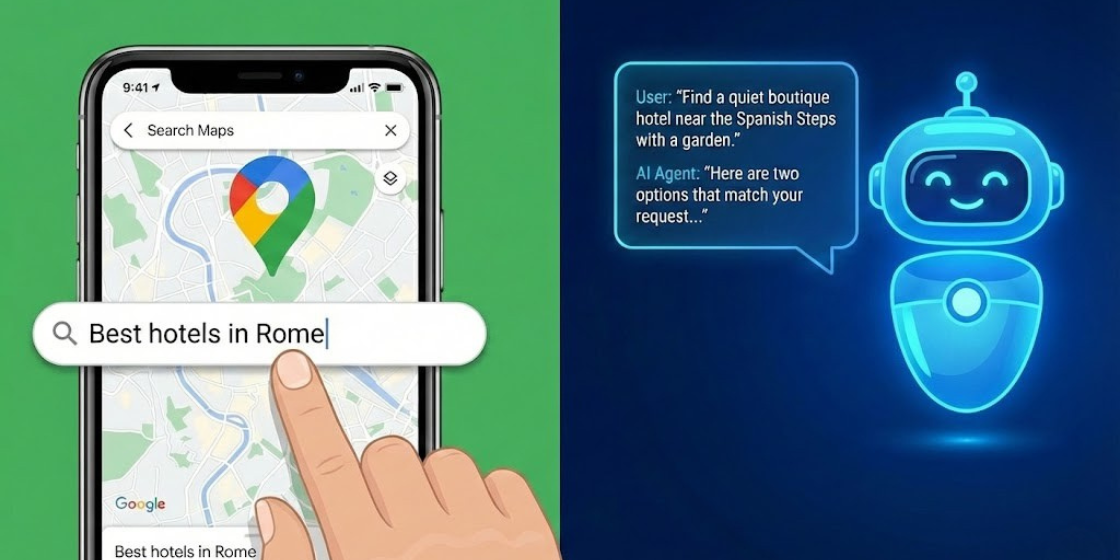
Google Ask Maps is a new AI-powered feature, launched in select US locations in late 2025, which is effectively meant to replace the traditional, often stagnant, Q&A section found in Google Business Profiles and Google Maps. It enables users to ask natural-language questions in the search bar to find, for example, "the best walking tour in [you name the place]" with results prioritized by up-to-date Google Business Profile data. Local results are returned in much the same fashion and format as they are today.
However, Google has also more recently launched a feature called Business Agent in its Merchant Center, which offers users a conversational experience in Google Search enabling shoppers to chat directly with your brand. You can even customize the agent to match your brand voice.
Business Agent pulls information from a brand’s website and its Merchant Center data, which enables it to give helpful, context-driven answers. This tool is using the Gemini LLM to analyze product data and any other business information you provide. I and others anticipate this same Agent functionality will be coming to Google Business Profiles in the not too distant future.
These two features, and particularly Business Agent, represent a fundamental shift from "Search" to "Conversation," where Google is no longer just an informational directory, but an active concierge. For local travel operators like tour companies and hotel owners, the introduction of Gemini-powered agents means your digital presence is no longer just for human eyes, it is now the "training manual" for the AI deciding whether or not to recommend you to a high-intent traveler.
For local operators, the "Ask Maps" evolution will drastically change how bookings are won. Instead of a user scrolling through dozens of reviews to see if a hotel is "quiet at night" or if a tour "allows for strollers," they will simply ask the AI. If your Google Business Profile (GBP) and website do not explicitly contain these granular details, the AI agent will either hallucinate a response or, more likely, pass you over for a competitor who has provided the data.
This "concierge-style" interaction moves the goalposts from ranking for broad keywords like "hotels in Miami" to winning specific, long-tail conversational queries such as "find me a boutique hotel near the beach offering vegan breakfast and has a workspace with fast Wi-Fi."
To respond effectively, travel operators must pivot toward data mastery. You should treat every section of your Google Business Profile, especially the Categories, Services, Products, and Update sections, as a key data point being consumed by an LLM bot. Don't just list a "Boat Tour"; list "2-hour Sunset Catamaran Tour".
Regularly updating Google Posts is no longer just for "engagement"; it serves as fresh "ingestion material" for the AI to understand your current offerings, seasonal changes, and operational status. The content published on your website and GBP needs to answer the hyper-specific questions a guest might have.
Further, to assist Gemini and other LLMs, the technical foundation of this new era is structured schema markup. By using schema markup for specific entities like Tours/Products, Itineraries/TouristTrips, HotelRooms, and VacationRentals you are essentially handing LLM bots a clean, machine-readable map of your business.
This ensures when an AI agent queries your data to answer a potential guest, it doesn't have to guess. High-quality, detailed website content covering "the tiny details" - from special amenities to specific room views - will be the differentiator enabling an agent to confidently move a user from "asking" to "booking."
Lastly, the ability to customize your brand voice within these agents offers businesses an opportunity to maintain brand identity within the Google ecosystem. For boutique hotels and niche tour operators, your "voice", be it adventurous, luxury, or family-friendly, can now be projected through the AI. This means your response strategy shouldn't just be about data, but about tone.
Ensuring your website copy and GBP descriptions reflect your unique brand personality will help the Business Agent interact with customers in a way which feels like an extension of your physical front desk, rather than a generic automated bot.
Business Agent hasn’t reached GBPs yet, but will your business be prepared when it does?
Stop Paying for Customers You Already Have: The New PMAX Unlock
.png)
by Zack Skinner, Associate Director Paid Media @ Propellic
Performance Max (PMAX) has long been one of Google's most promising campaign types, often hyped for its automation capabilities. While initial adoption came with challenges regarding control and transparency, recent updates have given advertisers much-needed visibility.
We’ve already seen improvements like increased search themes across asset groups, better search term visibility, and channel performance reporting. Now, Google has rolled out another promising feature: Data Exclusions for Performance Max.
From your campaign settings, you can now exclude specific customer lists directly from each PMAX campaign. This is a massive win for strategy because it allows you to:
- Refine Audience Targeting: Reduce spend on existing customers, or low quality site visits when your goal is new customer acquisition.
- Control Prospecting vs. Remarketing: Align your PMAX campaigns on new or returning customer depending on priority.
- Optimize Budget: Focus your spend on the core objective of your campaign, reducing blind spend.
This feature looks to be fully rolled out across accounts. Give it a try and see how it impacts your performance!
Travel Marketing AI Summit Sponsored by Propellic

On March 24th in NYC, Propellic is partnering with Phocuswright to drive the future of travel marketing at their upcoming AI Summit.
This is not a crowded trade show overloaded with hype. It is a curated executive forum designed to cut through the noise, focusing entirely on real-world strategy from leaders actually deploying these technologies at scale, including executives from Google, Hopper, Tripadvisor, and Booking.com.
If you are a senior marketing leader defining your 2026 roadmap, secure your spot now.
Get 20% Off the Prevailing Ticket Price
Conferences

Berlin, Germany | March 3 - 5 | Let’s Connect

New York, USA | March 24 | Let’s Connect
Celebrating Our People
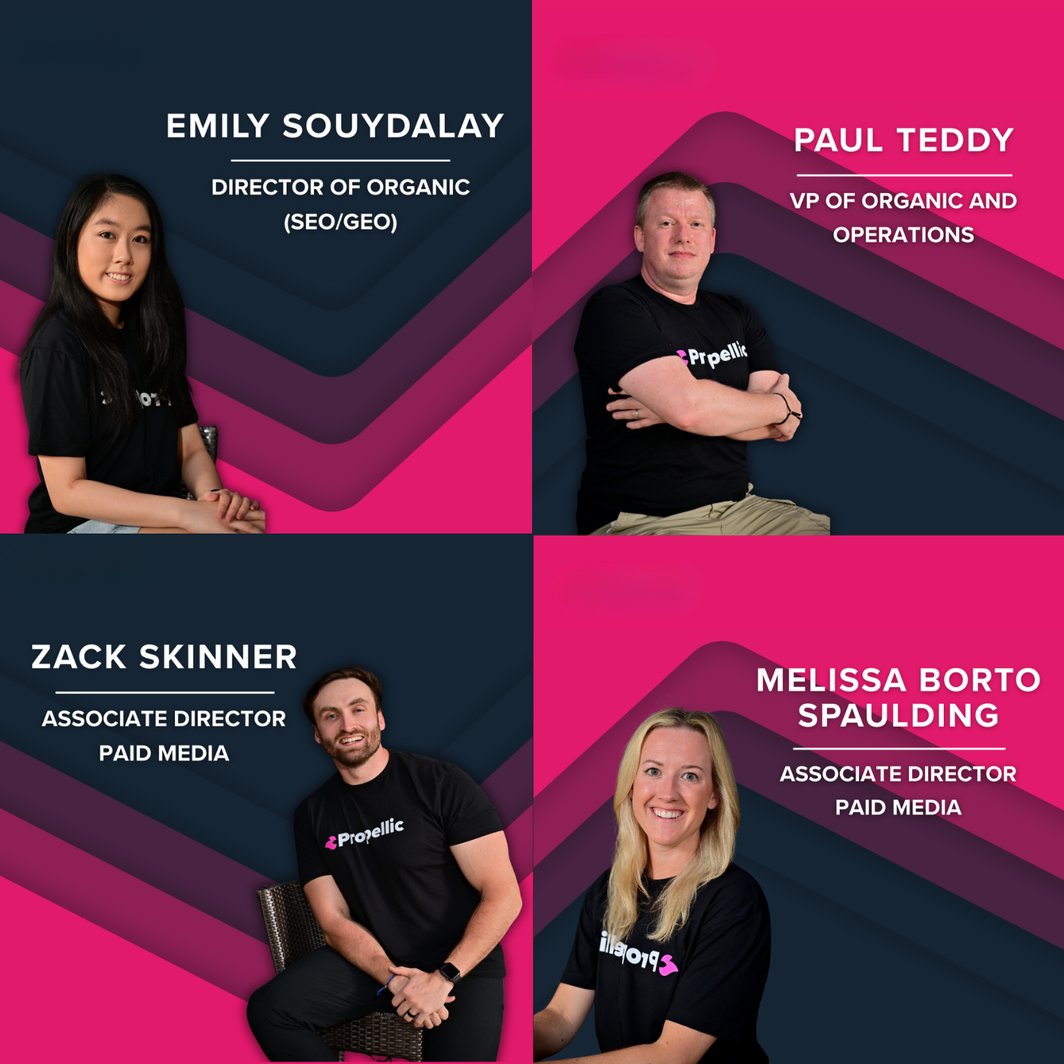
At Propellic, our people are our greatest strength.
Today, we celebrate four leaders who prove it:
Paul Teddy – VP of Organic & Operations From team member #4 to leading a team of 30, Paul has been the architect of our scale and strategy.
Emily Souydalay – Director of Organic (SEO/GEO) With 7 years of impact, she has evolved into a powerhouse leader, delivering unmatched quality every day.
New Paid Media Associate Directors
We are also proud to announce the promotions of Zack Skinner and Melissa Borto Spaulding.
Congratulations to the team driving our mission forward!
Want To Level Up Your Travel Marketing?
Subscribe to the NavLog, our bi-weekly travel marketing roundup, where you’ll be the first to know about breaking news that impacts travel marketers and access exclusive performance marketing strategies and practical tips you can implement from the marketers at the leading edge of the travel industry.
.png)