
PAID MEDIA
ChatGPT Ads adds conversion optimization, plus a pixel change that lands on 17 August

OpenAI shipped a run of ChatGPT Ads updates this week. Most of it can wait: oCPC in beta for product feed campaigns, new attribution integrations, better pixel diagnostics.
One item is not like the others. On 17 August, automatic advanced matching switches on for existing web pixels. You do not have to do anything for that to happen, which is the problem. If you would rather it stayed off, the window to say so closes the same day.
We broke down everything that changed, what it means if you sell travel, and the six things worth doing this week.
AGENTIC SEARCH
Google Confirms Agentic Hotel Booking Is Now in Testing
By Emily Souydalay - Director of Organic (SEO & GEO) @ Propellic

Google AI Mode can complete a hotel booking end to end. Participation is sequenced through partners today, which makes your distribution relationships part of your search strategy.
Google AI Mode can now take a hotel search all the way through to a completed booking without the traveler leaving the AI experience. Before treating that as the new default, read the eligibility notes. Google documents it as available only in the US, in English, for travelers signed into a Google account with a saved Google Pay method and a US address. Bookings complete only with participating booking partners.
Participating booking partners is the phrase worth sitting with. Not because it closes anything, but because it tells you the order things are happening in.
Visibility and participation are becoming two different problems
Most travel marketers still treat these as one job. They are separating.
Visibility in AI search is open to anyone who earns it. Participation in the booking transaction is sequenced, and right now it runs through partners. Two different levers, on two different timelines, and most teams are only pulling the first one.
The partner list is a starting line
When Google announced the capability on 17 November 2025, it named who it was starting with: Booking.com, Choice Hotels, Expedia, IHG, Marriott and Wyndham. In the same post it said it is “committed to partnering with travel companies of every size”. A starting line, not a guest list.
PAID MEDIA
Google Ads Travel Search Campaigns Expands For Things To Do & Events Beta
By Zack Skinner - Associate Director of Paid Media @ Propellic

Google very quietly unveiled an update to its Travel Campaigns. Previously, Google allowed you to create a Travel campaign and connect your Things to Do Center and use that feed to populate ads pulled directly from that feed. The campaign type only allowed tROAS bidding and was bare-bones with settings, not utilizing keywords or much of any control beyond your feed.
With the new update hinted at in their Q3 betas, Google has migrated Travel campaigns running the Things to Do Center feed and rolled them into a new campaign type, "Search Campaigns for Travel". These campaigns function along the same lines as a traditional search campaign, incorporating your Things to Do Center feed connection, a full AI MAX feature set, and keywords.
For those currently running a traditional Travel Campaign, be on the lookout for a non-communicated campaign migration to this new campaign type, as we've learned. Review the keywords, negative keywords, AI MAX settings, and review the feed performance to see how things have changed.
More features will inevitably be rolling out to this campaign type in the near future, but for the time being, keep a close eye on performance as Google continues to evolve this campaign type and feature set.
What Google actually announced. By Zack Skinner.
Google has expanded Search campaigns for Travel to an open beta covering the Things to Do and Events verticals. Google Ads announced it on 8 July, and Search Engine Roundtable reported it a day later.
Feed-based travel ad formats and text ads now sit in the same campaign, which Google says "allows you to centralize feed-based formats and text ads in a single place." Both get the standard Search campaign controls. Your feed can enhance your text ads, your keywords can optimize your Travel Promotion Ads, and the AI Max feature set comes with it, including Search Term Matching and item groups. Reporting consolidates into one view across multiple levels, with search term reporting included.
Targeting and reporting options adapt to your vertical. Hotels filter by item ID, location and hotel class. Things to do swaps in activity rating. Events adds participant and venue. Car rentals keeps item ID and location.
Google has also published a new help section on creating a Search campaign for Travel with AI Max.
Source: Search Engine Roundtable, 9 Jul 2026
INTERNATIONAL SEO
Scaling Hreflang: Moving International SEO Markup from HTML to XML Sitemaps
By Eric Wimsatt - Associate Director of SEO @ Propellic
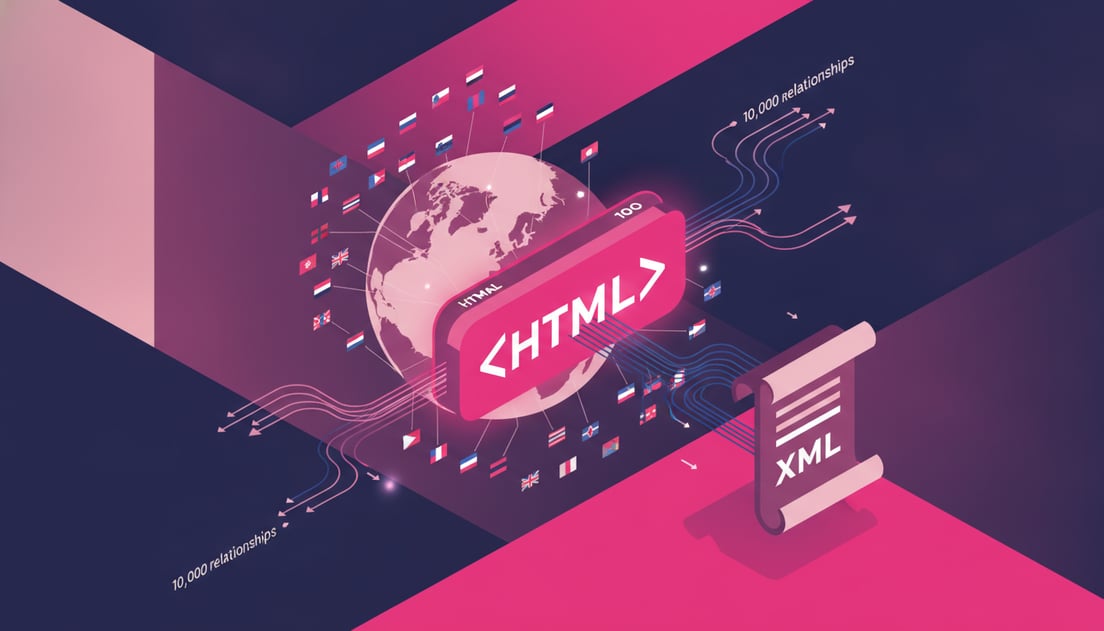
100 languages, 10,000 relationships, one very fat page head
Here is the problem. A site with over 100 language packs, and the standard SEO recommendation is to put every hreflang annotation in the head of every page. That is multiple KB of identical markup sitting above your actual content, on every page, at the moment you most want Google and the LLMs to reach that content fast.
HTML hreflang is not broken. It is fully supported and it works fine for five languages. It just does not scale, because language relationships grow N by N. Five versions is 25 relationships. A hundred is 10,000.
Google supports three hreflang methods and treats all three as equivalent. Only one of them keeps the markup out of your HTML.
Moving it there is the easy part. Doing it correctly is where most implementations quietly break, and that is the half of this nobody documents: how many entries the sitemap actually needs, which canonicals will fight your annotations, the file size limit that catches large sites off guard, and why your translation plugin generating 40 languages is not a reason to index 40 languages.
Want To Level Up Your Travel Marketing?
Subscribe to the NavLog, our bi-weekly travel marketing roundup, where you’ll be the first to know about breaking news that impacts travel marketers and access exclusive performance marketing strategies and practical tips you can implement from the marketers at the leading edge of the travel industry.