.png)

We all know people say one thing and then do another. So for a week, we watched travelers plan actual trips in the AI tools they already use to answer the question: ‘how are people using AI for trip planning?’.
What’s inside:
→ The research itself: eight findings from the study, each with what we'd do about it. It's relevant for the whole travel ecosystem - hotels, tour operators, destinations and OTAs. Report and webinar below.
→ You can now upload your customer lists into ChatGPT Ads, there's a new visual ad format running during image generation, and the first performance numbers just went public. What it all adds up to, and why suppression still comes first, from Melissa Spaulding, Associate Director of Paid Media at Propellic.
→ Meta and Sierra just announced a new standard in development for how AI agents deal with businesses.
→ A Skift piece on where distribution is heading because of AI. It doesn't land where you'd expect - and we've added our own relevant data to support it.
Read the full issue below.
NEW RESEARCH · OUT NOW
Eight Findings From A Week Inside Travelers' AI Sessions
Surveys tell you what people say they do, which is rarely what they do. So we watched instead. For a week, travelers planned real trips with the AI tools they already use, screens recorded, thinking out loud, across five activities from choosing a destination to the handoff to booking.
There were eight findings across the four stages of a trip, summarized:
Discover
1. Travelers stick to one AI. Most stayed inside a single tool all week rather than opening a second to check the first.
2. Big brands read as ads. There were multiple instances where a recognizable brand in an AI answer was written off as a paid placement even when they were organically referenced. A named local operator with a phone number read as real instead.
3. Structure earns trust. 70% trusted AI recommendations more than traditional search, and 25% said they trusted AI just as much as traditional search. We asked why, and they pointed at the comparison table and the ranked list, not at anything a brand had written.
Plan
4. Multi-day trips were self-planned. Asked to build an itinerary, all participants did not think to look for existing tour packages and wanted to build it themselves.
Evaluate
5. Reviews and photos decide hotels. Those are the two most-clicked elements of a listing. Self-written descriptions barely registered.
6. Irrelevant ads backfire. Most travelers saw no sponsored content all week. Among the ones who did see an ad, an unrelated placement made for a negative experience and they chose to start the prompt over. For those who saw an ad that gave them value, they remarked that it was "helpful" or "useful."
Book
7. AI points travelers direct. 71% were sent to book direct with the operator.
8. A recommendation standard, not a transaction standard. More than three quarters of booking handoffs failed to carry the dates and guest counts across, and travelers blamed the booking site rather than the AI.
Each finding comes with what to do about it.
PAID MEDIA
ChatGPT Ads Update: Customer List Targeting and Display Ads in Image Generation
by Melissa Spaulding, Associate Director of Paid Media @ Propellic

Two weeks ago I wrote that the problem with ChatGPT Ads is visibility, that you hand over Context Hints and OpenAI decides where your ad runs without ever showing you the conversation. That's all still the case, but there's a new piece worth knowing about, because your own customer data now works in there.
LiveRamp has expanded its OpenAI partnership, so you can now push first-party audiences into ChatGPT Ads through RampID. CRM records, loyalty data, site and app audiences. Target them or suppress them, the way you already do in Google and Meta. Search Engine Journal reports it's live in 11 markets to begin with, and LiveRamp says it'll follow ChatGPT Ads into new ones as they open.
You don't need LiveRamp for it, either. OpenAI takes Custom Audiences straight through Ads Manager. Upload a CSV of emails or phone numbers, hashed or not, include or exclude at campaign level, bid multipliers at ad group level.
At the same time, OpenAI just released display ads that will play during image generation. You ask for an image, and while it renders an ad appears beside it with product imagery and a "Learn More" button. It sits alongside the output rather than inside it, and OpenAI says it doesn't influence what the model produces. Testing starts this month in the US with a small group of advertisers.
The thinking behind it is sound, and worth understanding even if you never buy one. The pause already exists, so nobody gets interrupted, and someone who just asked for an image drawn is in exactly the frame of mind to look at a picture of something else. Keeping the generated image itself untouched matters more than it sounds, too. In our recent study of how travelers use AI, an irrelevant placement didn't just fail, it cost the whole answer its credibility and sent people back to start the prompt over. Sitting beside the output rather than inside it is OpenAI protecting the thing people came for.
For travel, the natural read is destination imagery, and it's the first ChatGPT Ads format where a tour operator or a hotel would have something obvious to show. You should still do a closed test though first.
So the feature list is catching up to Google and Meta without the performance data to match it, because ChatGPT Ads is still new, conversation context decides a lot of what gets served, and until last week nobody had published benchmarks for how these audiences or these display ads actually perform.
Roger Dunn went through OpenAI's latest announcement and pulled out the first numbers anyone has put in public about display performance in ChatGPT Ads. WeightWatchers reported an attributed CPA 15.3% below its blended paid search benchmark, Dose saw 67% of incremental purchases come from net-new customers, and Triple Whale put 93% of Portland Leather's ChatGPT Ads visitors in the new-visitor bucket.
Worth taking those for what they are. Three advertisers, none of them travel, each measured by a different partner, all surfaced by OpenAI in an announcement built to sell the channel. Nobody publishes the test that went badly.
If you're testing this, start with suppression. It's the one use where you don't need a benchmark to know it worked. Stop paying to reach the guest who booked last week. Keep existing customers out of an acquisition offer. Keep loyalty members out of a first-timer promo. You can measure that against your own spend instead of against numbers that don't exist yet.
Prospecting is the harder sell, even with those results. What they agree on is reach rather than efficiency, and OpenAI's minimum audience sizes still cap how narrowly you can segment, so you'd be buying into a channel with no travel track record. What I said in September holds, so I'd run suppression first because it pays without a benchmark, then prospect on its own budget with its own hypothesis rather than a slice off search.
Sources: Osmundson, Search Engine Journal · Roger Dunn on LinkedIn
AGENTIC BOOKING
Meta and Sierra Are Standardizing How AI Agents Deal With Your Business

Meta and Sierra announced the Personal Agent Protocol this week, an open standard they’re developing with Genesys, Instinct, Rocket, Shopify, Stripe and Walmart to define how personal AI agents interact with companies. Nothing is built yet, though a v0.1 spec is due later this month, with design workshops and a reference implementation to follow.
Today an agent uses your website the way a person does, loading pages and clicking forms, and when that fails it falls back to your support line or web chat. The protocol is designed to replace the clicking. An agent would discover what you offer from your site, open a session for its user, then work through whichever route you allow: your web pages, your APIs via MCP or OpenAPI, or your own company agent for anything needing a conversation. Authorization runs on OAuth, the customer chooses read-only or write access, and the session carries across channels.
The part worth noticing is that it’s built for your benefit as much as the agent’s. You decide what gets exposed, and you can see when an agent is acting for a customer instead of guessing. Payments extensions are on the roadmap, which would let an agent buy without the card details ever being shared.
Now read the partner list again. Payments, commerce, CRM, mortgages, retail, and no travel company anywhere in it.
That’s the part to sit with, because standards harden early. The decisions landing in the next few months, about what an agent can see, what it can do unprompted, and who carries the liability when it books the wrong thing, get made by whoever turns up. Google’s UCP covers hotels. This one covers everything else, and it’s being shaped by Shopify, Stripe and Walmart.
There’s nothing to implement yet, so the useful thing is to read the v0.1 when it lands and ask whether availability, cancellation terms and rate accuracy survive a standard written for shopping carts.
Source: Sierra
"This is opinion, not data, but I think the brands that implement this get preferential treatment from agents, because it reduces compute. If there’s an easier path to interact with a personal agent, that’s the path the agent takes." - Brennen Bliss, Founder and CEO at Propellic
TRAVEL TECH
Nothing Replaced Google, Which Turns Out To Be The Harder Outcome
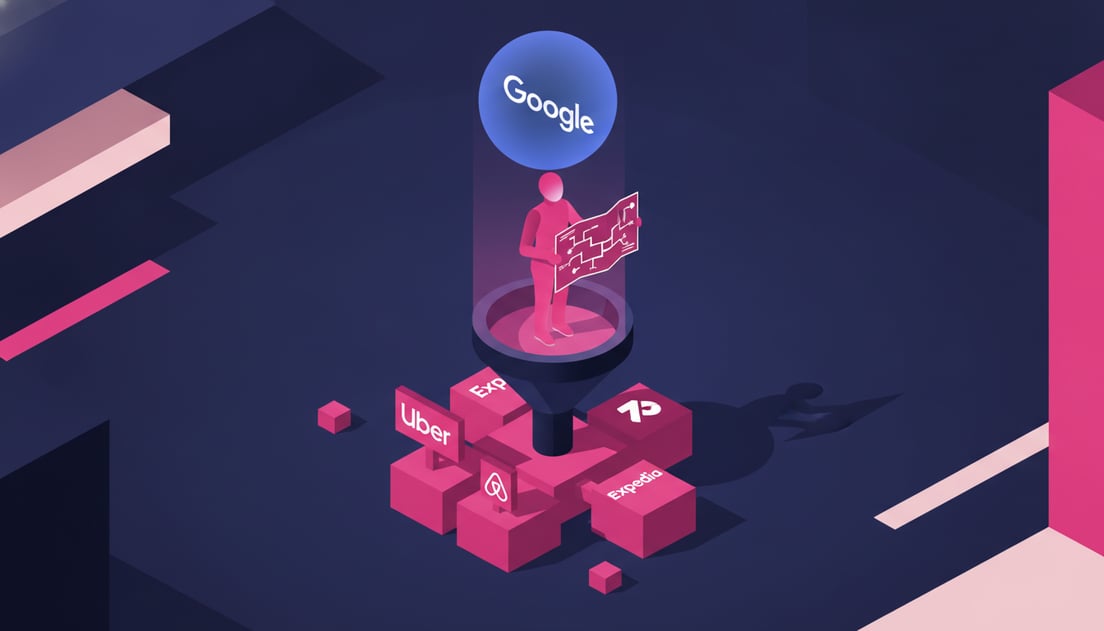
Skift came out of Global Forum with a question nobody could answer cleanly, which is who owns the customer once AI agents become a normal part of travel. After sessions with the CEOs of Uber, Booking Holdings, Expedia and Airbnb, their conclusion was that the question itself is too tidy to be useful.
The old shape was a funnel, where a traveler typed intent into a search box, Google usually saw it before anyone else did, and airlines, hotels and OTAs competed for the click that followed. It was always messier in practice than the diagram suggested, but the logic held well enough that the industry spent billions getting in front of that moment.
What everyone expected after ChatGPT was a straight swap, one gatekeeper out and another in. Skift's argument is that it hasn't gone that way at all, and that distribution is fragmenting across many starting points rather than consolidating behind a new one.
What we'd add. Our own research suggests the fragmentation is real at the market level while being almost invisible at the level of the individual traveler, because most of the people we watched settled into one AI tool and stayed inside it for the whole week rather than opening a second one to check the first, the way they'd have opened another tab in search.
So there's no single gatekeeper any more, but every traveler still has one of their own, and that's a harder environment to work in than the old funnel. Under Google you could be weak on one engine and recover on another, whereas now, if you're missing from whichever tool a traveler has settled into, you're missing from their trip entirely and there's no second tab coming along to rescue you.
What changes when you're targeting both the traveler and their personal agents? What does and doesn't translate to the end traveler when they've shared specific context with their AI agent? AI visibility work actually has to cover more, from earning a ranking on one surface to maintaining presence across every surface a traveler might settle into, saying the same thing on each of them.
Source: Skift · The State of AI Visibility for Travel in 2026
Want To Level Up Your Travel Marketing?
Subscribe to the NavLog, our bi-weekly travel marketing roundup, where you’ll be the first to know about breaking news that impacts travel marketers and access exclusive performance marketing strategies and practical tips you can implement from the marketers at the leading edge of the travel industry.