



You did not set out to build a complicated portfolio. Each new domain made sense at the time: a new market, an acquisition, a product that needed its own identity, a brand that could confuse customers if it lived under the parent. Now you are managing five websites, multiple ad accounts, and a backend that nobody can keep up with.
The question you are sitting with isn’t "should or shouldn’t we consolidate?" It is "How can we structure and prioritize our brand domains to optimize performance and reduce operational challenges?"
The goal of this guide is to help you develop a framework for making the call on what to keep, what to merge, and what to finally let go.
01. The real cost of running multiple domains
The most obvious costs are operational. Every domain you maintain is a full stack of recurring obligations. Most executives undercount them until they add them all up.
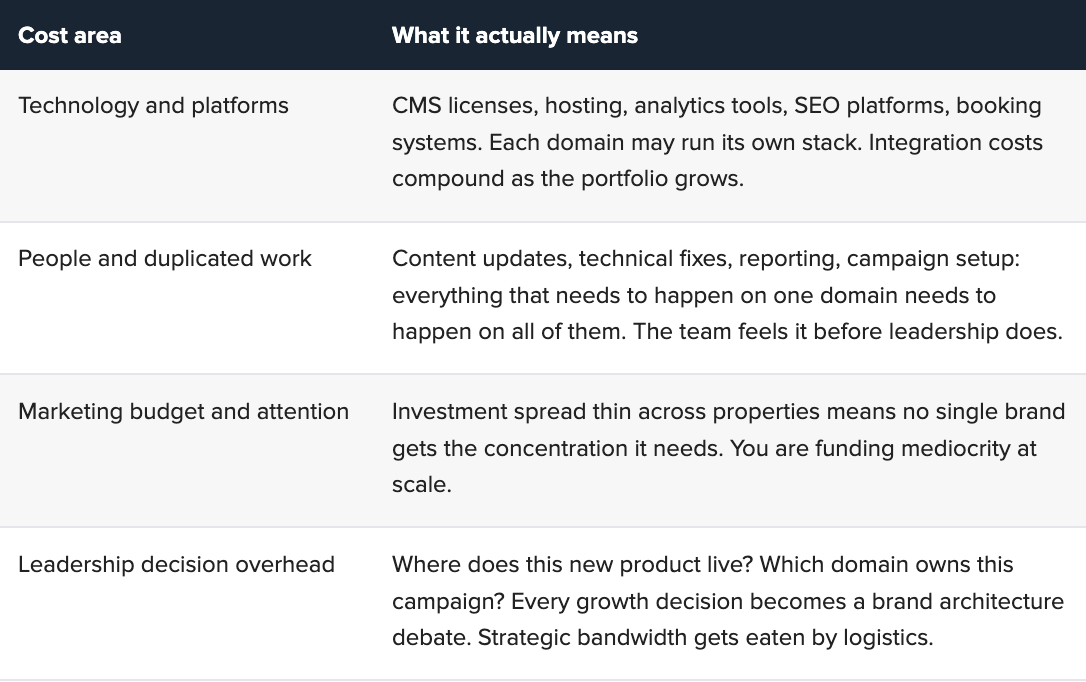
"We had five websites. Nobody owned any of them well. We were maintaining all of them adequately and growing none of them significantly."
The operational drag is real and measurable. But it is the smallest part of the problem. The invisible costs, what fragmentation does to your search presence and your ad spend, are larger. Most brands do not connect them back to the portfolio structure.
02. What this does to your SEO and AI visibility
Search engines, and increasingly AI answer engines, reward authority. Authority is built through consistent, concentrated signals: content depth, backlinks, engagement, and entity coherence. A fragmented portfolio works against all of these simultaneously.
You are diluting the authority you have already earned
Every backlink your brand earns through press, partnerships, or content lands somewhere in your portfolio. When those links point to five different domains, no single property builds the domain authority needed to dominate competitive queries. You are spreading your most irreplaceable asset across properties that may never reach critical mass on their own.
You are cannibalizing your own rankings
If multiple domains compete for the same queries, Google has to choose between them. It usually picks one and suppresses the other. In practice, you lose the combined ranking potential both pages could have delivered under a single authoritative domain.
AI VISIBILITY
AI answer engines like ChatGPT, Perplexity, and Google's AI Overviews identify "authoritative entities." Fragmented, duplicate inventory across multiple domains signals low authority. Consolidation is not just an SEO play anymore. It is an AI visibility play.
You are making content investment less efficient
Every piece of content competes in a search landscape with a finite number of ranking positions. Content published on a domain with moderate authority has a lower ceiling than the same content on a domain with concentrated, high authority. A fragmented portfolio means your content team does more work for lower returns, often without knowing why.
03. What this does to your paid media spend
The paid media consequences of a fragmented portfolio are less discussed but often more immediately measurable. The core problem: when multiple domains enter the same ad auctions, you are bidding against yourself.
You are inflating your own CPCs
Google's ad auction sets prices based on competition. When two of your brands both bid on the same query, the combined cost to win those clicks is higher than a single consolidated campaign would pay. That premium goes entirely to the platform. It does not reach a single additional customer.
Your Smart Bidding campaigns cannot optimize properly
Modern paid media, Google's Performance Max and Meta's Advantage+, runs on machine learning optimized from conversion signals. When conversions are split across multiple domains and ad accounts, each campaign gets a fraction of the signal it needs. Campaigns stay in the learning phase longer. Bid strategies do not tighten. Cost per booking stays higher than it should be.
AFTER CONSOLIDATION
One domain, one ad account, one pool of conversion data. Smart Bidding has more signal, optimizes faster, and cost-per-booking typically drops, sometimes significantly, within the first 60 to 90 days. This is one of the most measurable returns from a consolidation, which is why we baseline paid metrics before migration.
What consolidation typically delivers on paid
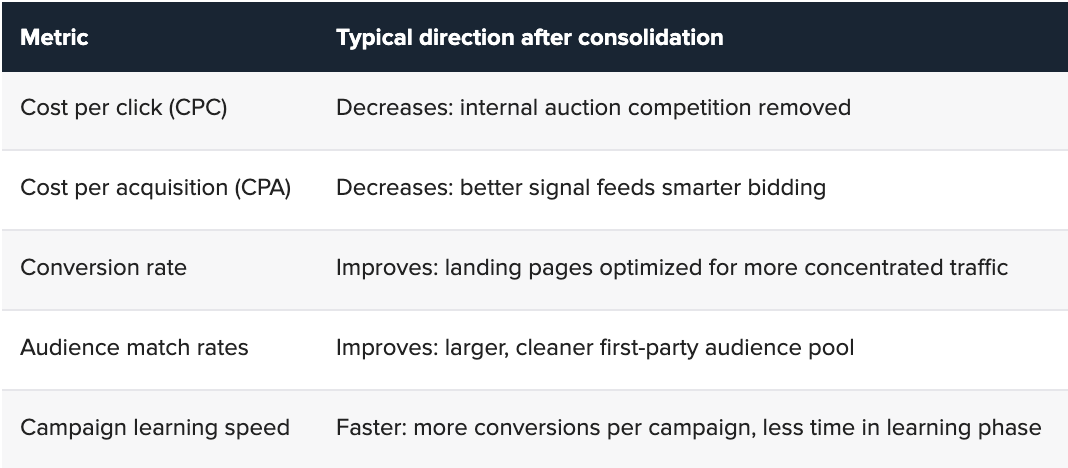
These are directional, not guaranteed. How much you recover depends on the degree of overlap and how cleanly the consolidation is executed.
04. The framework: what to keep, merge, or sunset
The first question in a consolidation is not "how do we move things." It is "what deserves to move at all." Every product, service, and domain in your portfolio needs to earn its place on the new one. Score each offering against these five signals.
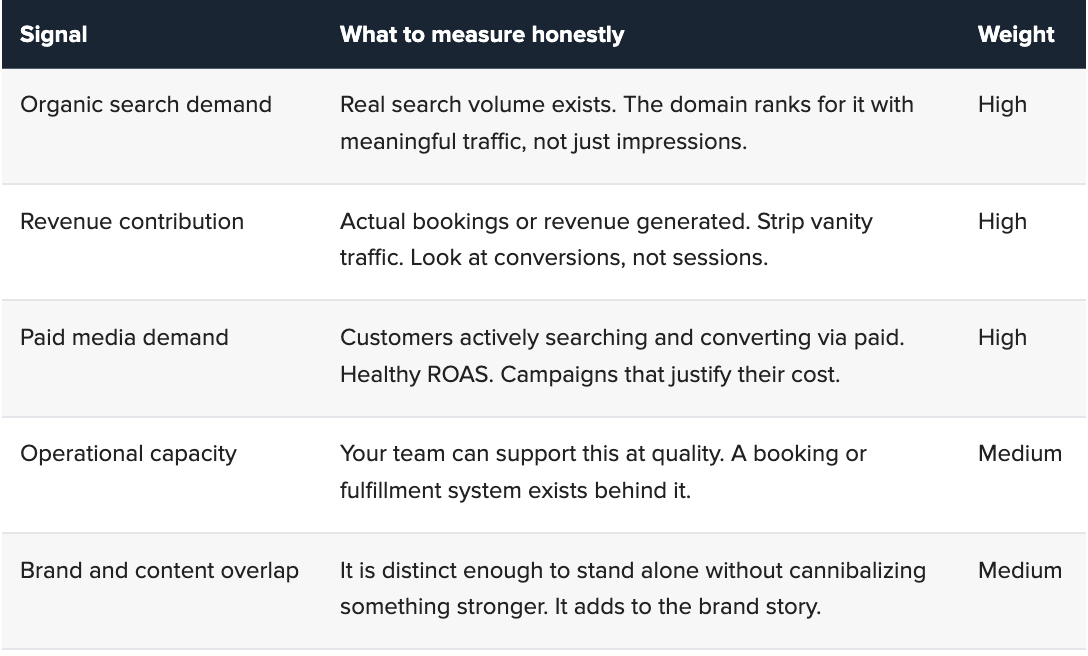
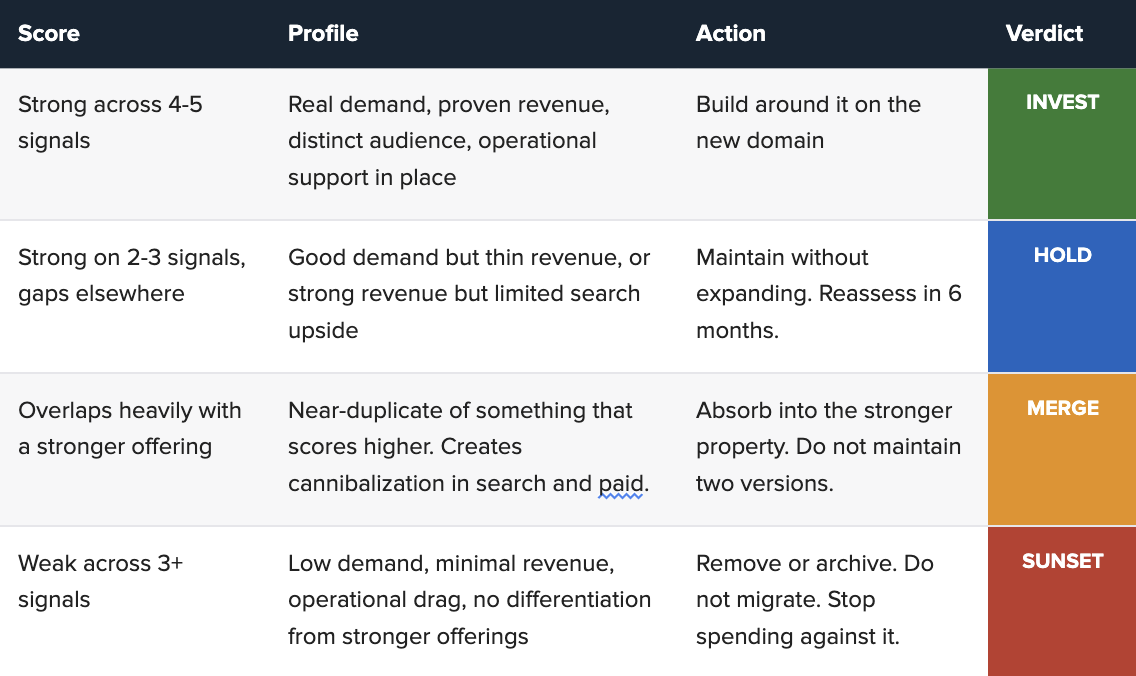
The four verdicts
THE HARDEST PART
Most executives already know which offerings would score Sunset. The framework does not create that answer: it gives you permission to act on what you already suspect. Migrating everything is a copy-paste, not a consolidation.
05. Applying the same logic to individual pages
Once product and service decisions are made, the same logic applies at the URL level. Every page needs an action assigned before migration begins.
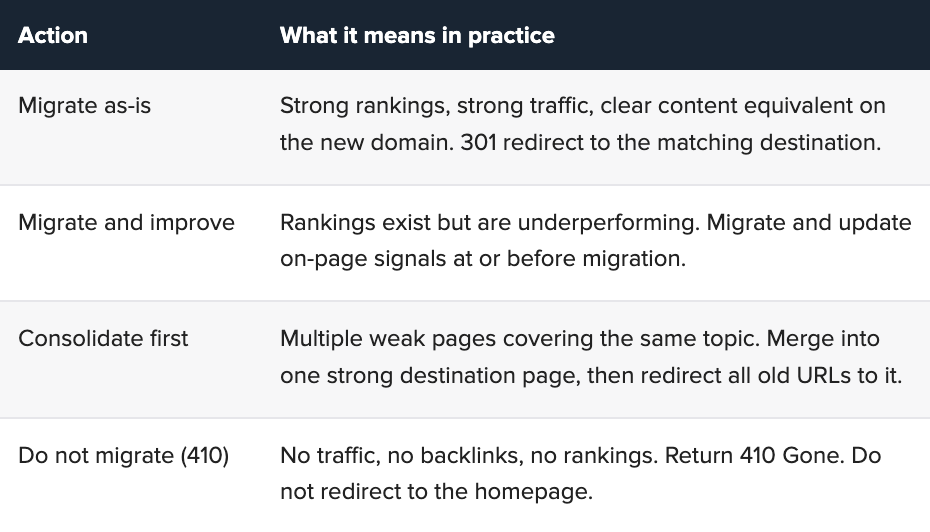
THE HOMEPAGE REDIRECT TRAP
Sending retired pages to your homepage tells Google the content was deleted, not moved. It stops passing authority through redirects that clearly do not match the original content. Use 301 only when a genuine equivalent page exists. Use 410 for everything else.
06. What the technical migration actually requires
Audit first, everything else depends on it
- Organic baseline: GSC data for every domain, including indexed pages, top URLs by clicks and impressions, and keyword positions.
- Paid baseline: ad account performance by domain, including spend, CPC, CPA, conversion volume, and audience pool size.
- Backlink inventory: referring domains via Ahrefs organized by Domain Rating. High-DR links to specific URLs are the most irreplaceable asset. Know where they are before moving anything.
- GBP listings: if any domain powers Google Business Profile listings, those update on a separate track and timeline from organic rankings.
The destination domain must be ready before migration day
Redirected authority and paid traffic both land on whatever is there when they arrive. Build the destination first. Core pages live and indexed, on-page signals finalized, conversion tracking verified, and paid campaigns pointed at the new domain, all before any redirect goes live.
Redirect rules that are not negotiable
- Every page with traffic, backlinks, or rankings gets a 301 to its closest equivalent, mapped one-to-one, not in bulk.
- Never redirect everything to the homepage. Google stops passing authority to destinations that do not match the original content.
- Clean redirect chains on both domains before layering consolidation redirects on top. Chains leak authority at every hop.
- Allow 3 to 6 months for full authority transfer. Ranking fluctuation during this window is expected. Reverting early destroys the work.
THE PRESERVATION PRINCIPLE
No domain is retired until data confirms the destination can absorb its traffic and revenue. If consolidating multiple large properties, migrate in phases rather than shutting everything down simultaneously.
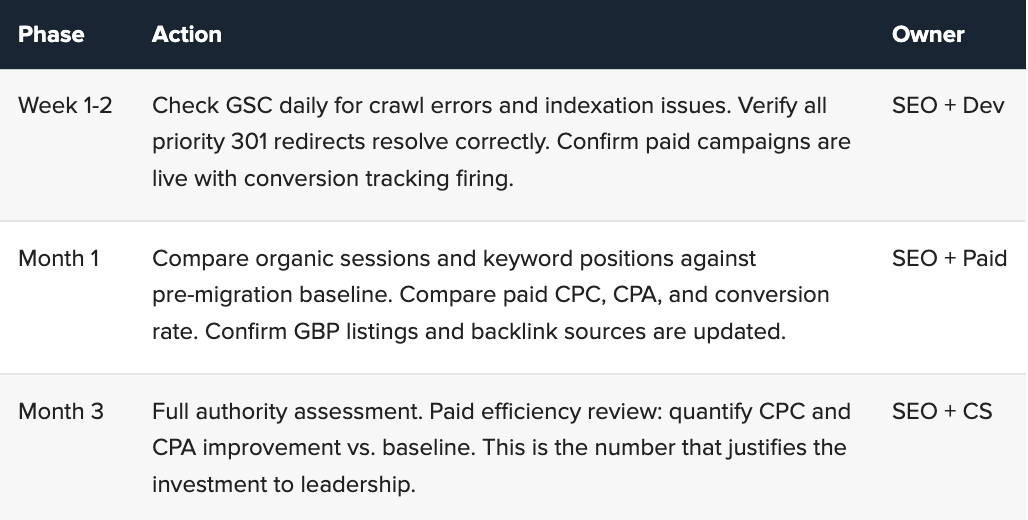
07. How to monitor and measure success
Most problems in a consolidation surface gradually, over weeks, not hours. Your monitoring window is 90 days minimum.
Pre-launch gate: if any of these are open, the migration date moves
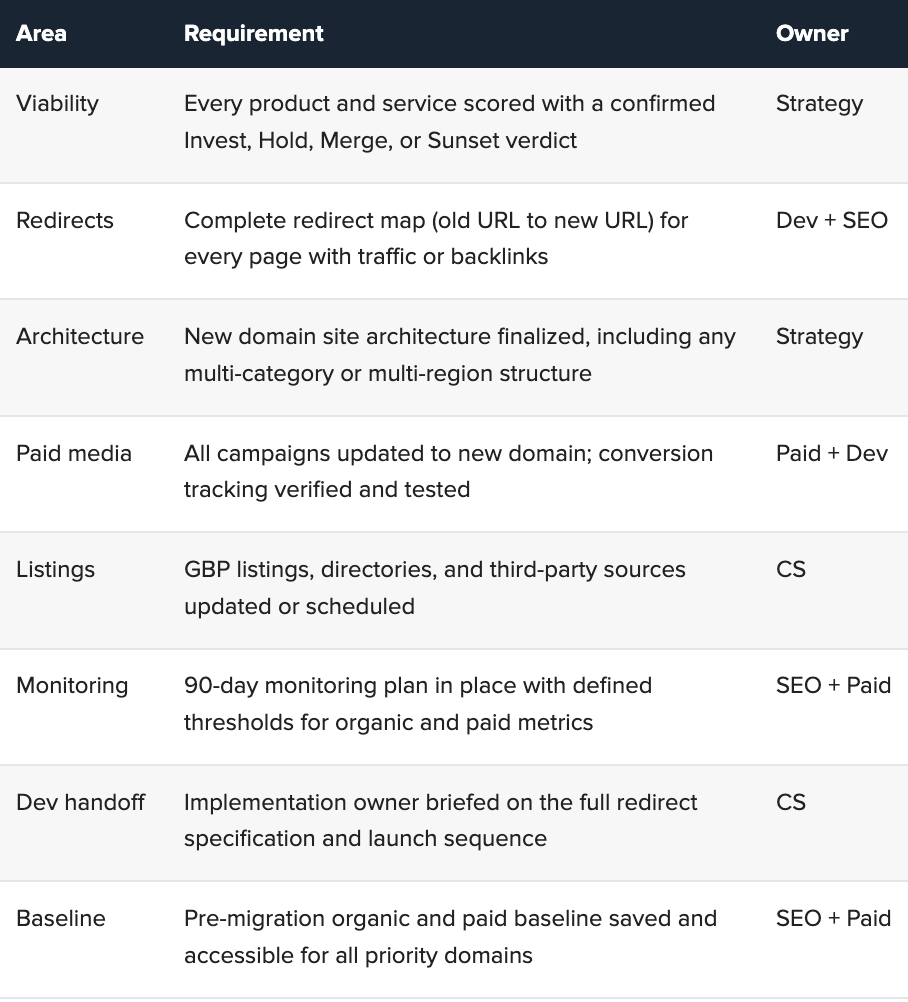
IF ANY ARE OPEN
The migration date moves. The cost of a delayed migration is a few more weeks of operational drag. The cost of an underprepared migration can be months of suppressed rankings and inflated ad spend.
Working through this decision?
Working through this decision? Send us your portfolio and we will tell you honestly whether consolidation is worth it. Sometimes the answer is no.
Want To Level Up Your Travel Marketing?
Subscribe to the NavLog, our bi-weekly travel marketing roundup, where you’ll be the first to know about breaking news that impacts travel marketers and access exclusive performance marketing strategies and practical tips you can implement from the marketers at the leading edge of the travel industry.



.png)
