.png)

Through September 2026, Google automatically upgraded remaining eligible Search campaigns using automatically created assets or the campaign-level broad match setting to AI Max. Google expected all eligible upgrades to conclude by the end of September.
There was no opt-out. The only way to avoid it was to stop using those features before the upgrades began.
The confusion worth clearing up first
In April, Google announced that Dynamic Search Ads, ACA and campaign-level broad match would all auto-upgrade starting in September. In June it revised that: DSA sunset and auto-upgrade moves to February 2027, because advertisers said they needed more time.
The same update was explicit that ACA and broad match campaigns would continue to be auto-upgraded starting in September 2026. That reprieve was never general.
If your read of the coverage was "we have until 2027," that is only true for one of the three.
What your account inherited
Google configured the upgraded campaigns to mirror the legacy setup, which keeps performance stable and also means nobody chose the new settings deliberately.
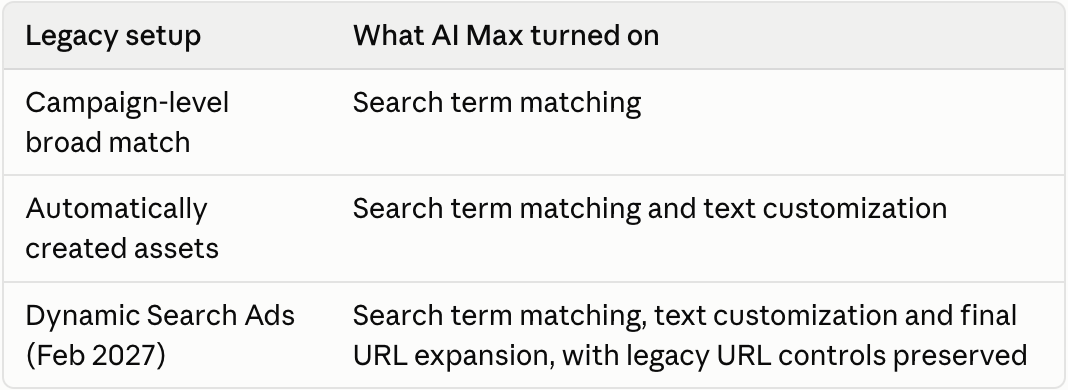
Alongside the upgrade, new DSA campaigns can no longer be created through Google Ads, Google Ads Editor or the API.
Why this matters more in travel
Search term matching widens which queries a campaign can serve against. In most categories that is a manageable trade. In travel it collides with a structural problem: your brand terms, your destination terms and your competitors' destination terms sit close together in a way that few other verticals deal with.
A campaign that starts matching more loosely around "things to do in Lisbon" is not obviously wrong. It is just no longer doing what the person who built it intended, and the report will not say so.
The second issue is portfolio-shaped. If you run several domains or several ad accounts, this happened in all of them, at slightly different times, with settings mirrored from whatever each account happened to be doing.
What to check this week
- Which campaigns moved. Check account notifications and campaign settings rather than assuming. Google sent notices before the transition.
- What search term matching is now bringing in. Pull the search terms report from before and after the upgrade date for each affected campaign. This is the fastest way to see the actual change.
- Whether your negatives still cover you. Negative keyword lists built against tighter matching may not hold against looser matching.
- Text customization output, if you had ACA. Read what is being generated. It is your brand voice on a page you did not write.
- CPA and ROAS across the upgrade date, not just the trailing 30 days, which will blend the two periods and hide the step change.
The pattern underneath
This is the second time this year Google has moved travel advertisers into AI Max without asking. Earlier, travel campaigns running a Things to Do Center feed were migrated into a new Search campaign type with no announcement at all.
The direction is consistent, and it is worth planning around rather than reacting to each time. Assume more campaign types will move. Keep a written record of every campaign's intended configuration, because after an automatic upgrade the account is no longer a reliable record of what you chose.
Sources: Google Ads blog, 15 April 2026, updated 11 June 2026, Search Engine Land
Want To Level Up Your Travel Marketing?
Subscribe to the NavLog, our bi-weekly travel marketing roundup, where you’ll be the first to know about breaking news that impacts travel marketers and access exclusive performance marketing strategies and practical tips you can implement from the marketers at the leading edge of the travel industry.